Last week we talked about what happens after you train.
Training creates stress.
Recovery allows your body to repair and adapt.
And over time, that process is what makes you fitter.
But there is another part of that equation we need to understand: what exactly are you recovering from?
Your body does not neatly separate the stress you create in the gym from everything else happening in your life.
A hard workout is stress.
A busy week at work is stress.
Poor sleep is stress.
Kids getting sick, travel, relationship challenges, and long days all add to the total load your body is trying to recover from.
Some of those stressors are physical.
Some are mental or emotional.
Some are completely outside your control.
But your body still has to deal with the total load.
And this is where recovery becomes so important.
If you want to build fitness, your body needs the opportunity to recover from the stress you place on it.
Remember what we spoke about last week.
Training creates fatigue and places stress on your muscles, tendons, ligaments, bones, energy systems, and cardiovascular system.
Then your body has to repair that damage, restore what has been used, and adapt so it can handle a little more next time.
For that to happen, it needs resources.
It needs enough food to fuel repair and replenish energy.
It needs protein to help rebuild tissue.
It needs carbohydrates to restore energy stores.
It needs fats to support healthy cell membranes, hormone production, and nervous system function.
It needs fluids to replace what you lose through sweat and breathing.
It needs sleep, which plays an important role in repair, restoration, and recovery.
And it needs periods where you are not continually asking it to do more.
If you regularly pile stress on top of stress without giving your body enough opportunity to recover, eventually that process can start moving in the wrong direction.
Fatigue can accumulate.
Performance can drop.
You might feel flat, unusually sore, or constantly tired.
Little niggles can start hanging around.
Your training can stop progressing.
And if that cycle continues for long enough, you can start losing some of the fitness you have worked hard to build.
This is why recovery is much more than taking a rest day.
It is about making sure the amount of stress you are adding is something your body has the resources to adapt to.
Some stressors are difficult to change.
You might not be able to make work less busy this week.
You cannot control whether your child wakes you up three times tonight.
You cannot always avoid travel, illness, or difficult things happening in your life.
But the stress you create in the gym is usually much more within your control.
This is where an important question comes in.
Instead of asking:
“How hard can I push myself today?”
Try asking:
“What can my body reasonably recover from today?”
Some days the answer might be:
“A really hard session.”
You are well rested, well fed, feeling good, and ready to go.
Push.
Other days, life has already asked a lot from you.
Maybe you slept badly.
Maybe work has been huge.
Maybe you are carrying some soreness from the last few days.
That does not automatically mean you should skip training.
It might simply mean reducing the load, slowing the pace, choosing an appropriate scaling option, and leaving a little more in the tank.
That can still be productive training.
In fact, sometimes that is exactly what allows you to keep moving forward.
Recovery does not have to be perfect.
Life is rarely going to give us perfect conditions.
The goal is to become better at recognising the stress you are carrying, supporting your recovery where you can, and choosing a training dose that your body can adapt to.
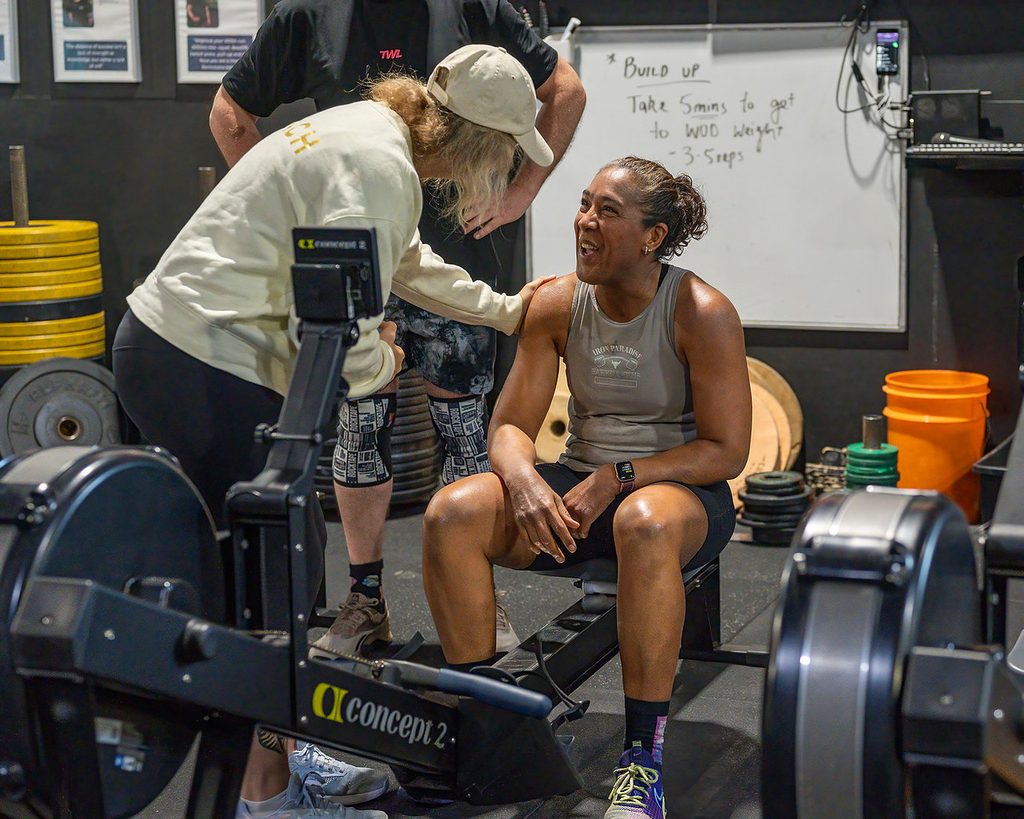
As coaches, that is one of the things we are thinking about when we ask how you are feeling before class.
We are not only asking what you are capable of doing today.
We are thinking about what you are capable of recovering from.
BECAUSE FITNESS IS BUILT WHEN STRESS AND RECOVERY WORK TOGETHER.
Talk to you soon,
Lindsay